
Workplace collaboration: What workers say they need, and how to design for it
Almost everyone agrees teamwork matters. Far fewer offices are built to support it. A global study asked more than 3,000 workers what is present when collaboration works best, and the answers are strikingly consistent across countries. Here is what they said, and what it means for the rooms and furniture you put on your floor.
What the research covered
The Steelcase Active Collaboration Study 2019 spoke to more than 3,000 executives, managers and individual contributors in organisations of different sizes in Australia, France, Germany, Japan, the United States and the United Kingdom. Active collaboration is a concept inspired by Steelcase research from the classroom, which discourages passive activity in favour of more active, engaged behaviours.
The agreement was near unanimous: 97% said teamwork is crucial and 93% said it helps generate better ideas. Notably, there were no significant differences in the study based on age, which undermines the common assumption that generations want fundamentally different things from collaboration.
The barriers teams run into
The global findings identified four recurring obstacles to successful collaboration. All four are at least partly a design and technology question rather than a management one.
- Lack of access to the right people
- Lack of access to information
- Outdated technology
- Rampant distractions
The movement gap
One finding deserves separate attention. The research identified a significant gap between those who wanted to move while collaborating, 72%, and those who could, 53%.
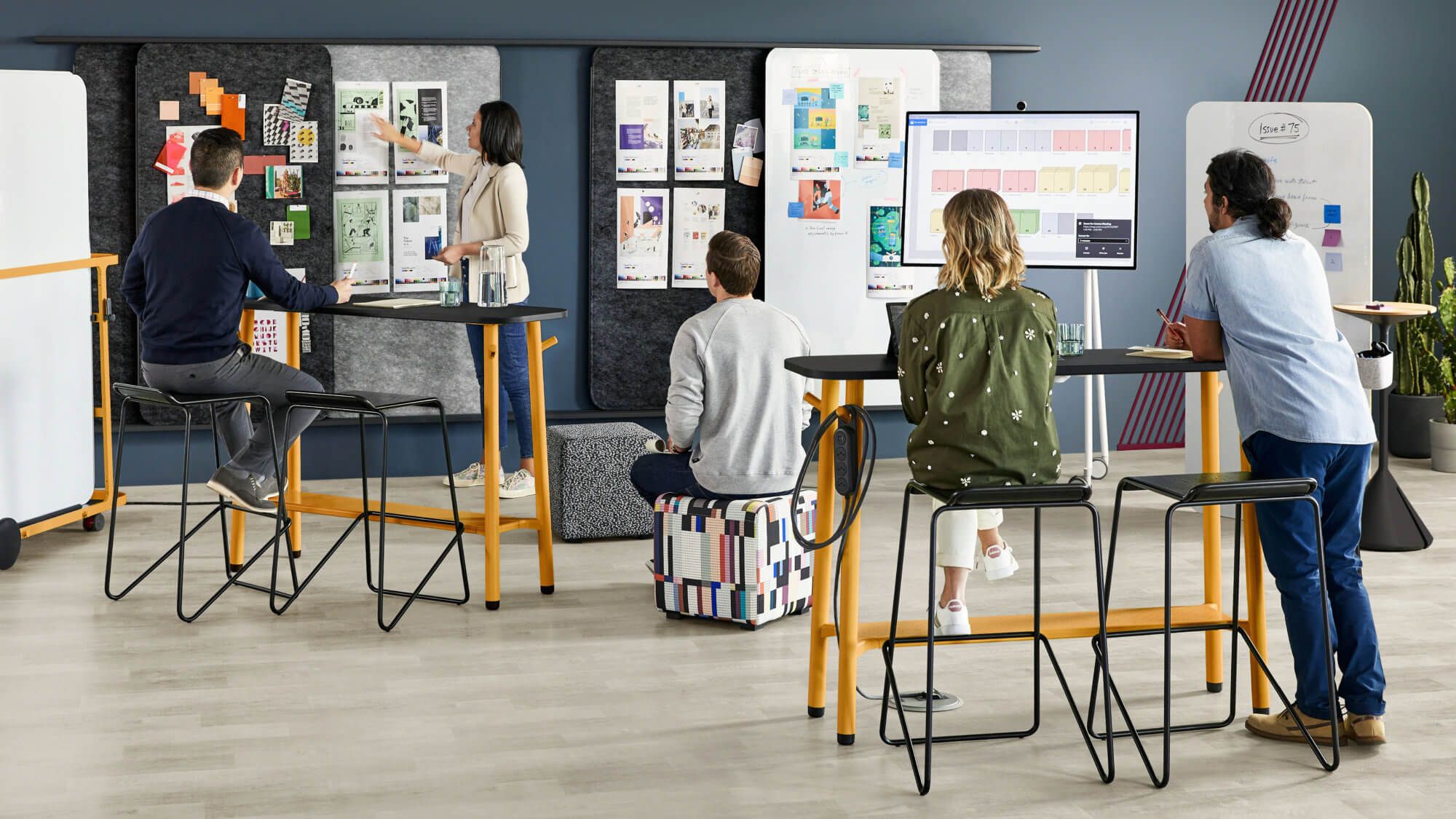
That gap is usually furniture. Heavy tables, fixed seating and screens mounted for one viewing position quietly force people to stay still, even when the work would benefit from standing up, moving to a wall or regrouping.
What is present when collaboration is at its best
Steelcase asked people which factors are present when collaboration works best. Ranked by how often they were named:
- The team listened to each other — 64%
- The team had a shared purpose — 60%
- The right people were in the room — 52%
- Team members were able to build on each other's work — 51%
- Had access to all needed information — 49%
- The team was able to focus without distraction — 44%
- The team could display relevant information or previous work — 43%
How the answers varied by country and company size
Australian employees consistently ranked these conditions higher than average: listening at 70%, shared purpose at 66%, the right people in the room at 60% and building on each other's work at 61%. US employees also rated listening at 70%, building on each other's work at 60% and access to information at 56%.
Japanese employees ranked focus without distraction lowest of all countries at 25%, and displaying relevant information at 29%. Excluding Japan, the global averages rise to 48% and 46% respectively, helped by Australia at 55% for focus and France at 51% for display.
Company size mattered too. The larger the organisation, the more important listening, shared purpose and having the right people in the room became, and larger organisations valued building on each other's work especially highly. Executives placed more weight on focus without distraction and on displaying information than managers or individual contributors did.
Three design principles for active collaboration
Active collaboration encourages people to become more physically, mentally and emotionally engaged in generating ideas. The Steelcase Applications Design Studio offers three principles for creating spaces that support it.
- Encourage movement. Use light-scale furniture so teams can shape a space to fit their needs, and provide seating that supports perching or standing postures.
- Encourage equal participation. Provide co-creation tools such as large-scale collaboration devices that make ideas visible and let everyone contribute to and interact with content.
- Create an ambient connection to the space. Build a welcoming environment and design spaces that encourage people to experiment, supported by integrated technology.
Turning the findings into a floor plan
Read the list of best-case factors again and most of them have a spatial equivalent. Listening needs acoustics. Shared purpose and building on each other's work need visible, persistent content. The right people in the room need spaces that are easy to book and easy to join remotely. Focus without distraction needs separation from open, noisy zones.
Alternativ designs and builds those settings as part of a complete office project, from layout and partition walls to the furniture inside them.
Scroll or drag
Frequently asked questions
Listening. In the Steelcase Active Collaboration Study 2019, 64% of workers said the team listening to each other was present when collaboration was at its best, ahead of shared purpose at 60%.
The study found no significant differences based on age. The conditions needed for successful collaboration were consistent across generations and across the six countries surveyed.
Because far more people want it than can have it. 72% wanted to move while collaborating but only 53% could, which usually points to furniture and room layout rather than behaviour.
Use light, movable furniture, provide tools that make ideas visible to everyone, and create a welcoming setting with integrated technology that invites people to experiment.
Want collaboration spaces your teams actually choose to use?
Contact Alternativ to design them into your office.