
Sensory office design: How the five senses shape focus at work
You can measure desks, light levels and temperature, but what people remember about an office is harder to count: the colour of a wall, the smell of the wood, the texture of a chair. Sensory office design treats those details as working tools. Here is the research behind it and how to use it.
Why the intangibles belong in your brief
Workplaces that focus on the intangibles, meaning sight, smell, hearing, taste and touch, are better equipped to support employee wellbeing.
Even the best employers can miss this. Ergonomic seating, height-adjustable tables, views outdoors and break rooms all matter, but what about the colour of the walls, the smells in the office, or the texture of the furniture? It is through the five senses that humans perceive the world, notes Il Prisma architect Elisabetta Pero.
Putting a number on the senses
Italian firm Il Prisma, a Steelcase distributor, decided these qualities should be quantified rather than left to aesthetic intuition. It ran a scientific study of how the five senses in an office affect people neurologically, using electroencephalograms (EEG scans) to measure electrical activity in the brain and an eye tracker to detect eye movement and dilation of the cornea.
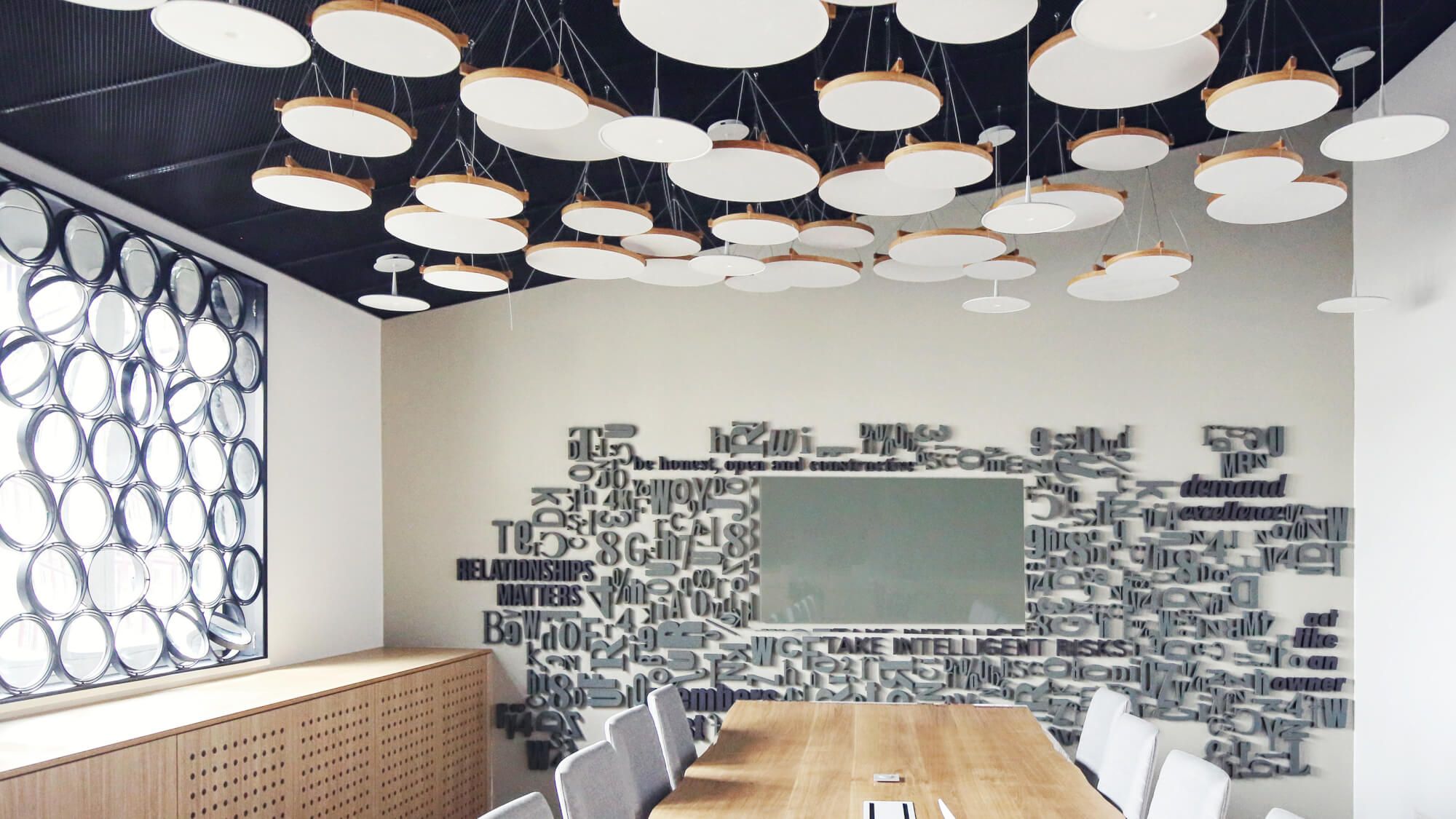
The study ran in two phases. First, the architects contrasted a neutral room, a basic meeting room with a white conference table and homogenous lighting, with a sensorial room: a wooden table and rough, fragrant cedar bookcases, three wooden chairs each of a different design, a curtain made of leaves, a blue light behind a bookcase and food on the shelves. Subjects in both rooms performed a problem-solving test.
In the second phase, subjects were shown pictures of colours and images, such as blue fabric or types of workspaces. These prompted neurological responses similar to those that would occur if they were holding the fabric or standing in those environments.
More stimulation is not always better
You might expect the sensorial room to win every time. It did not. Engaging multiple senses can also have a negative effect, depending on the task. The sensorial room might be better for writing a long memo, Pero explains, but it may not be as ideal for group problem solving.
Participants in the sensorial room did perform well on the individual listening task. While memorising, learning and studying, they remembered and reproduced more words and showed heightened concentration compared with those in the neutral room. The study also found that blue and green, and the use of wood and natural materials, promoted calm and relaxed brain states.
The six states of mind behind the design
The measurements tracked which mental states a space switches on. These are the states Il Prisma worked with:
- Attention — receptive to incoming external stimulation
- Focus — able to concentrate on the details of the activity at hand
- Learning — able to recall memories to classify new information
- Evocative — able to link and compare a stimulus with previous experience
- Simplicity — able to grasp what the stimulus communicates; when inactive, cognitive fatigue sets in
- Calm — relaxed and willing to interact with the environment; when off, it inhibits decision making
How LinkedIn applied it in Milan
Il Prisma used its research to create LinkedIn offices in Milan, Munich, Paris and Madrid. In Milan, under a theme of transformation, rooms represent five typical Italian locations: a theatre, a restaurant, a tailor's shop, a cellar and a garden. Each was designed with the study results, which the architects call emotional grammar, to suit the tasks done there.
In the Cellar, people can drink a glass of wine while listening to music, with cedar wood present. It suits highly private meetings or intense concentration. In the Tailor's Shop, sensorial elements are muted for problem-solving meetings: large swaths of fabric and metal, but no colour or texture that attracts undue attention. Together the five rooms form an ecosystem, so people can match the work they have to the setting that supports it.
What this means for your own office
The takeaway is not a formula. Il Prisma was looking for a method that helps personalise settings for the tasks carried out and the people doing them. The research concludes that the contemporary worker prefers places that are no longer antiseptic and standardised, but customised and with strong connotations. The full study is published in a book, Now We Work, adopted as an academic textbook in European universities.
In practice, name the task each room has to serve, then choose materials and light to match rather than repeating one finish everywhere. Alternativ builds that thinking into a design-and-build project, so sensory choices are made with the brief instead of after it.
Scroll or drag
Frequently asked questions
It is designing a workplace around sight, smell, hearing, taste and touch, so materials, colour, light and sound actively support the task done in each space.
No. Il Prisma found that engaging multiple senses can have a negative effect, depending on the task. A stimulating room may suit writing or learning yet hinder group problem solving.
The study found that blue and green, along with wood and other natural materials, promoted calm and relaxed brain states.
Want to give every room in your office the atmosphere its work deserves?
Talk to Alternativ about your project.