
The advantages of a co-working space (also if you are not a start-up)
Your office design and layout has a huge impact on your team's well-being. Ergonomic office chairs reduce the risk of neck and back issues, for example. Less obvious is that the building itself matters too. A co-working space can be good for your team and for your budget, and here is why.
What a co-working space actually is
A co-working space is a business area where employees from various organisations work together under the same roof. Most of these spaces combine zones retained for a single organisation with shared areas that everyone uses.
When you picture this type of office, you probably picture start-ups. The significant benefits are just as real for established companies, which is why more of them now rent part of a shared building rather than a whole one of their own.
Networking happens in the collective spaces
The shared parts of a co-working space are usually the kitchen, the coffee corner, the relaxation area and sometimes the meeting rooms. Those collective areas are where the real value sits.
They are incredibly valuable in terms of networking. Unexpected collaborations start there, and your team members may well pick up the best practices of a business in a completely different sector. Cross-industry innovation has never been so tangible.
For a company that has been in the same building for a decade, that exposure is often the strongest argument of all. New ideas arrive without you having to organise anything.
Good for your image, good for your costs
Co-working spaces are also beneficial for your image. Customers and potential customers are often impressed by this type of working environment, and that positive impression carries over to the products and services you offer.
The financial side is simpler still. Sharing infrastructure with other organisations means sharing the bill for it:
- Utilities and building services
- Meeting rooms you only need occasionally
- A staffed reception you would otherwise fund alone
- Cleaning, maintenance and facility management
Stamp your identity on your part of the building
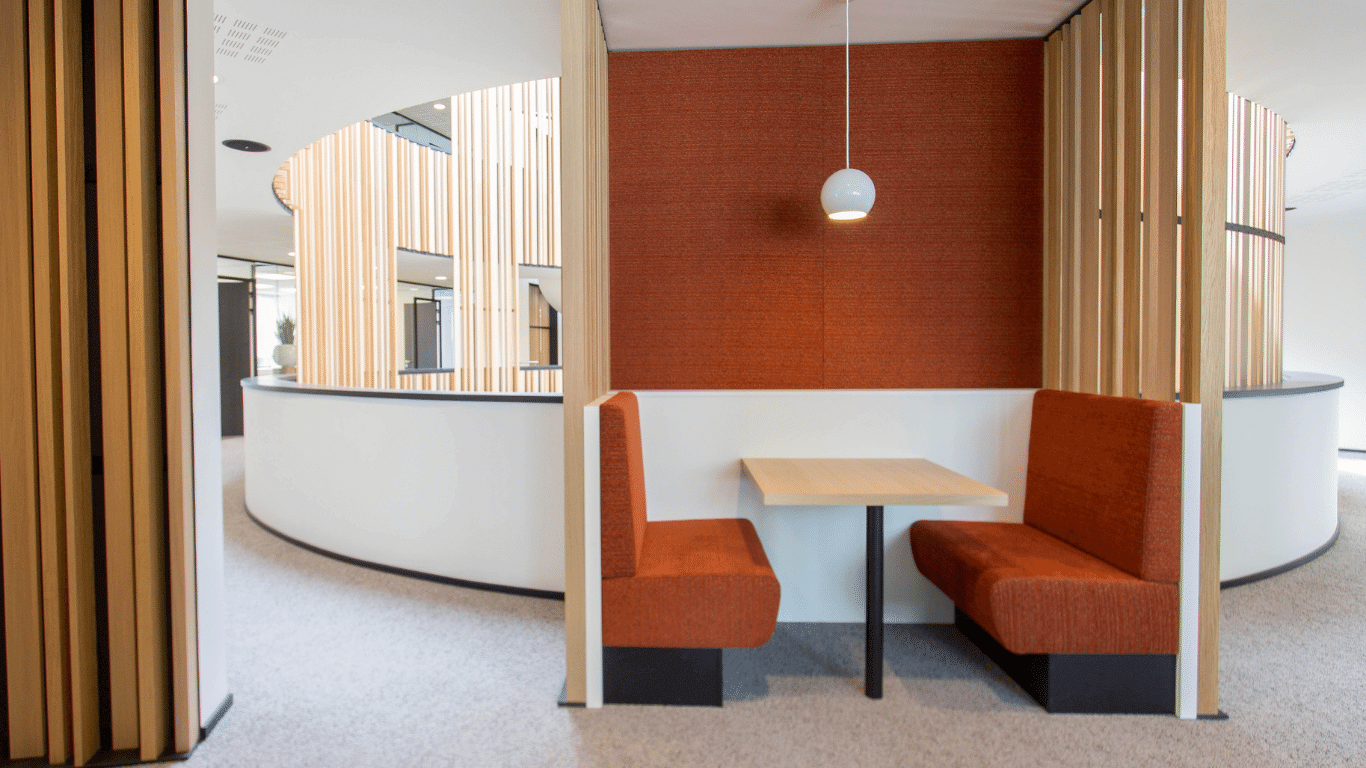
Sharing an office building with other organisations does not mean you have to give up your own look. The space used only by your employees should be immediately recognisable as yours.
Use colours from your brand palette, your logo where it makes sense, and whatever else fits your identity. Your company identity certainly does not have to get lost in a co-working space. Quite the opposite.
Practical ways to make a rented zone feel like your own:
- Brand colours on furniture, upholstery and acoustic panels
- Removable or modular partition walls that mark your perimeter without permanent works
- Your own lighting, rugs and planting for a distinct atmosphere
- A small welcome area where you receive your own clients
What the research says about connection
A common worry is that people will feel less attached to their own employer in a shared building. A study by WeWork, an American property company with a range of shared working spaces in its portfolio, looked at exactly that, and the results were published in Harvard Business Review.
Participants responded to statements such as I have a lot in common with the employees from the companies in my office building, versus I have a lot in common with the colleagues from my company. Researchers then gave each participating company a score from 1, the weakest emotional and psychological connection with their own organisation, to 5, the strongest.
The result: the majority scored a very healthy 4. Employees feel just as connected to their organisation in a co-working space.
When a co-working space is not the right answer
A shared building is not a fit for everyone. If your work involves confidential conversations all day, if you need specialised infrastructure, or if your teams depend on a layout that cannot be standardised, a dedicated office usually wins.
It is also worth checking the practical details before signing: the acoustics of the shared zones, how meeting rooms are booked at peak times, and how much you are allowed to change in your own area.
Designing your zone in a shared building
Whether you rent a floor, a wing or a corner, the same design rules apply: match the layout to your activities, separate focus from collaboration, and make the space unmistakably yours.
Alternativ designs and builds those zones, from partition walls and furniture to the finishing touches that carry your branding.
Frequently asked questions
It is a business area where employees from different organisations work under the same roof, combining zones reserved for each company with shared facilities such as the kitchen, coffee corner and meeting rooms.
No. Established companies gain the same benefits: shared infrastructure costs, a wider network and a working environment that impresses clients.
A WeWork study published in Harvard Business Review found employees feel just as connected to their own organisation, with the majority of participating companies scoring 4 on a scale of 1 to 5.
Yes. The area used only by your team can carry your colours, your logo and your own furniture, so your identity stays visible.
Curious how your zone in a shared building could look and feel like yours?
Contact the Alternativ experts for a first conversation.