
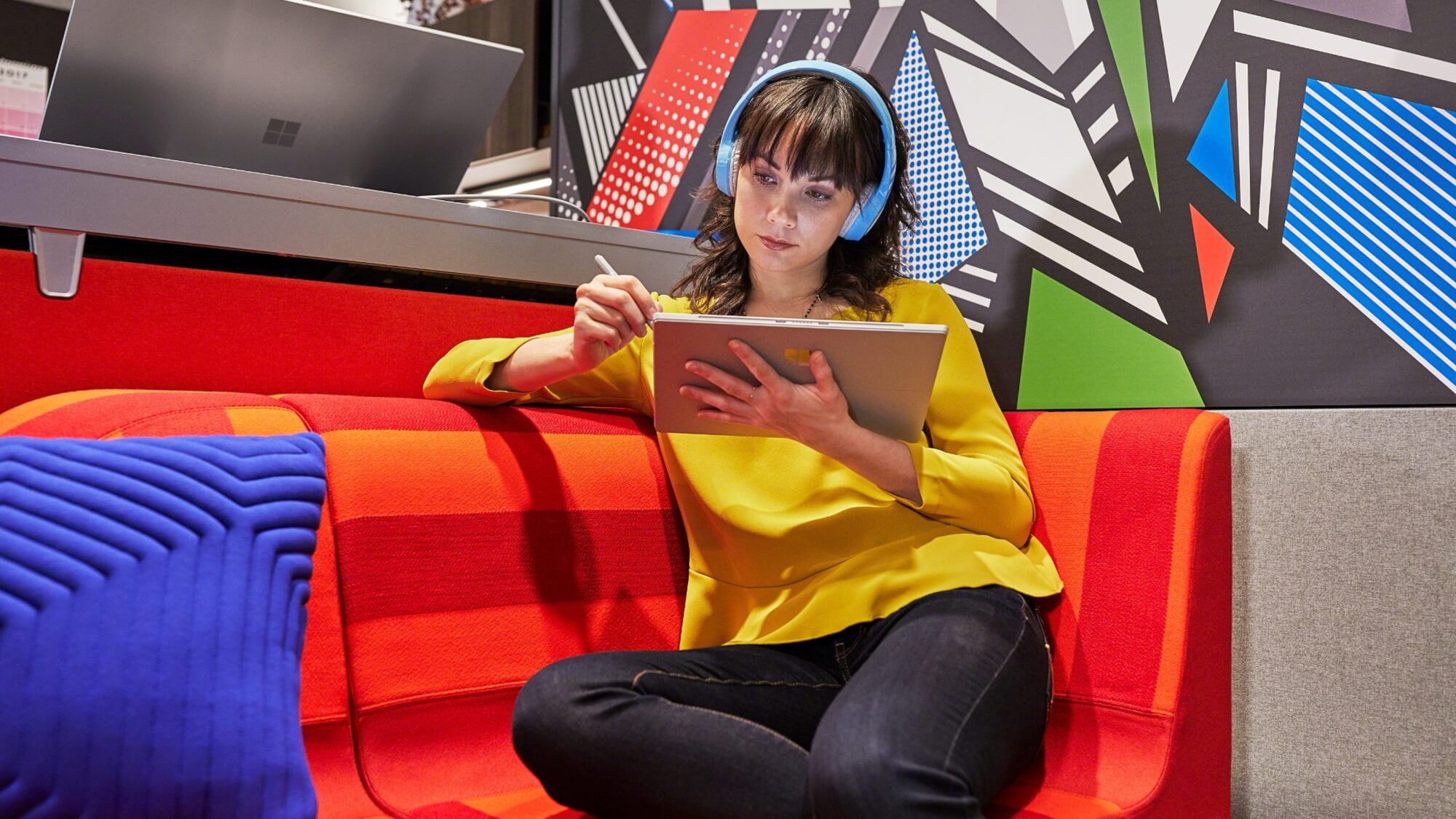
And what if agile working was meant for you?
Agile has left software development and spread into marketing, HR, finance and product teams. If yours is adopting it, the method will change how people meet, decide and concentrate. Your office has to keep up, or the new rituals get squeezed into rooms that were never built for them. Here is what agile working is and what it asks of your space.
What agile working actually means
The word agile means quick-minded and lively. Put it into the world of work and it comes to mean responding more quickly, which is close to the truth.
Agile methods take an iterative approach, making progress by repetition rather than in a straight line, and an incremental one, bringing added value to every piece of a project. It is an empirical and flexible method that involves the client from the beginning to the end of the project, and in which adjusting to change becomes a priority.
Where it came from
In February 2001, seventeen leading figures in software development met to compare their methods and debate a unifying approach. Out of that meeting came the Agile Manifesto, which recommends among other things that at regular intervals the team should think about ways of becoming more efficient, then adjust and modify their behaviour accordingly.
Since that meeting, agile working has stopped being strictly a computing matter. It is something of a state of mind, arguably a philosophy, and it has been taken up by many high-performance businesses well outside software.
Stand up: the vocabulary of agile
Three rituals turn up in almost every agile team, and each one has a physical consequence.
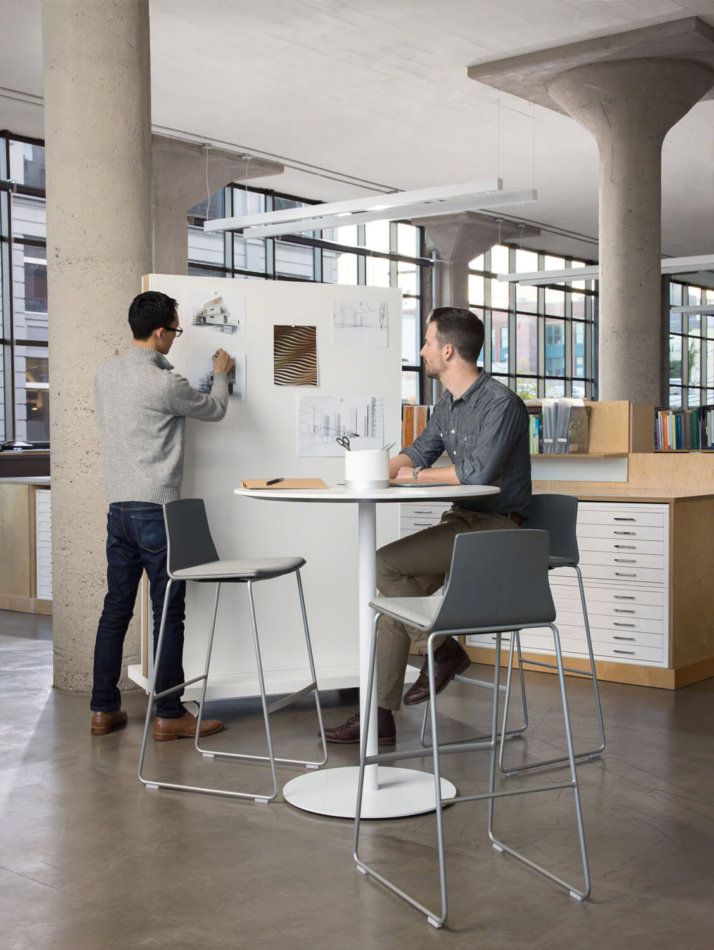
- Standups — fast meetings where participants stay on their feet, to check that the team is aligned and moving together
- Sprints — a short deadline set to complete one defined piece of a project
- Scrums — a list is made of the customer's requirements and prioritised based on costs, after which the length of the associated sprints can be set
Why the method changes the space
For agile working to be something everyone experiences, new links have to be created between people and their individual and collective workspaces. You need an environment geared to the targets you have set.
Agile working lets companies act on their new ideas, but as Tim Brown, CEO of the American design company IDEO, whose achievements include the Apple mouse, has explained, new ideas are not created from the agile method itself. They come from the way those ideas are quickly reiterated, improved and rolled out. The space either accelerates that loop or slows it down.
Four recommendations for an agile workspace
Researchers at Steelcase have worked at length on reorganising workspaces to keep teams agile. Their recommendations are specific:
- For standups — hold them in a room away from the main work area, so there are no distractions
- For sprints — create a workspace where people can concentrate while staying attentive to the team, which is where height-adjustable desks and meeting tables earn their place
- When hosting a client — design a space with an area for taking notes on the action points everyone has approved
- For tasks demanding high concentration — use a public setting such as a cafe, a rest area or a green space
Is agile working meant for you?
Agile is not a universal answer, and adopting the vocabulary without the behaviour helps nobody. A few honest questions will tell you whether it fits.
- Does your work arrive in changing requirements rather than fixed specifications?
- Can the client or internal stakeholder realistically stay involved from start to finish?
- Are your teams allowed to change how they work after a retrospective?
- Do people currently shift between solo and group work several times a day?
- Is there anywhere in your office to hold a five-minute standup without booking a room?
Modularity is the common thread
An agile workspace is usually modular, because flexibility, adaptability and speed are part of the agile culture. Fixed walls and heavy furniture make a team wait for facilities every time the work changes shape.
Modular partition walls, movable screens and height-adjustable furniture let a floor follow the sprint. That is the practical test of an agile office: how long does it take your team to change the room themselves?
It is also how Alternativ approaches a fit-out, thinking twice to deliver once, so the space still fits when the way of working moves on.
Scroll or drag
Frequently asked questions
An iterative and incremental way of working that progresses through repetition, adds value at every step, involves the client from beginning to end, and treats adjusting to change as a priority.
From a meeting of seventeen leading software development figures in February 2001, which produced the Agile Manifesto. The approach has since spread far beyond computing.
A standup space away from the main work area, height-adjustable furniture for sprints, a client space for recording agreed action points, and public settings such as a cafe or green space for deep concentration.
Because flexibility, adaptability and speed are part of agile culture. Modular walls and movable furniture let teams reshape their space as quickly as the work changes.
Thinking about an agile way of working?
Ask Alternativ how to make your office keep pace with it.